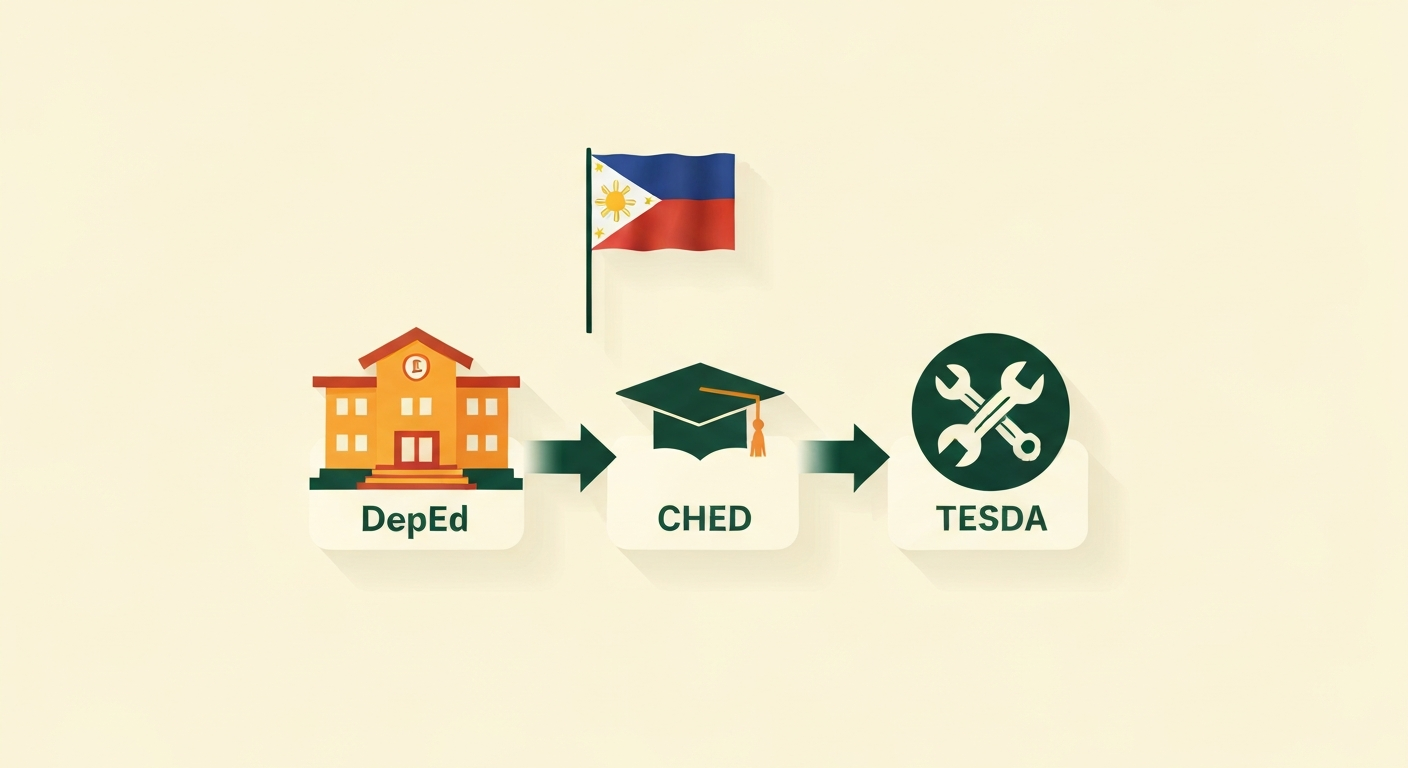
TL;DR: DepEd (Department of Education) regulates basic education from kindergarten through Grade 12 (K-12). CHED (Commission on Higher Education) regulates college and university programs leading to bachelor's, master's, and doctoral degrees. TESDA (Technical Education and Skills Development Authority) regulates technical-vocational education, certificate programs, and short skills training. Each agency operates independently under different mandates and laws — the trio together covers every level of formal education in the Philippines.
Is CHED under DepEd?
No. CHED is not under DepEd. CHED, DepEd, and TESDA are separate, co-equal agencies, each created by its own law. Before 1994, all Philippine education sat under one department; Congress then split oversight by level:
- Republic Act 7722 (1994) created CHED to focus exclusively on tertiary education quality.
- Republic Act 7796 (1994) created TESDA to focus on workforce-relevant skills training.
- Republic Act 9155 (2001) restructured DepEd to focus on K-12 basic education.
The split gave each level dedicated leadership and clearer accountability, but the boundaries still confuse families, especially around senior high school and post-K-12 pathways.
What does DepEd stand for?
DepEd stands for the Department of Education, the agency regulating Philippine basic education from kindergarten through Grade 12 under Republic Act 9155.
What does DepEd oversee?
DepEd regulates everything from preschool through Grade 12, including:
- Kindergarten (mandatory under RA 10157)
- Elementary (Grades 1-6)
- Junior High School (Grades 7-10)
- Senior High School (Grades 11-12) — including all SHS strands (STEM, ABM, HUMSS, GAS, TVL, Sports, Arts and Design)
- Alternative Learning System (ALS) — see our ALS guide
- Special Needs Education
- Indigenous Peoples Education
What does DepEd do?
- Sets curriculum standards (the K-12 framework, MATATAG, and successor curricula)
- Issues permits and recognition to private K-12 schools
- Operates all public elementary and high schools
- Administers the Senior High School Voucher Program for private school subsidies
- Implements the deworming, school feeding, and basic health programs
- Manages national achievement tests (NAT) and other K-12 assessments
How to Recognize a DepEd-Regulated School
Any basic education school — public or private — that offers Kindergarten through Grade 12 falls under DepEd. Look for:
- DepEd permit number displayed on the school's website or admissions materials
- DepEd school ID for public schools
- Recognition status for private schools
If a private school cannot show a DepEd permit, that school is not legally authorized to operate.
What does CHED stand for?
CHED stands for the Commission on Higher Education, created by Republic Act 7722 (1994) to regulate Philippine college and graduate programs.
What does CHED oversee?
CHED regulates tertiary education programs, including:
- Bachelor's degrees (4-5 year undergraduate programs)
- Master's degrees
- Doctoral degrees
- Diploma programs at the tertiary level
- Specialized professional programs (BS Nursing, BS Pharmacy, BS Architecture, BS Accountancy, BS Education, BS Engineering, etc.)
What does CHED do?
- Sets minimum curriculum standards (Policies, Standards, and Guidelines or PSGs) for every degree program
- Recognizes new HEIs and authorizes new programs
- Confers Center of Excellence (COE) and Center of Development (COD) status to top programs
- Grants autonomous status to high-performing private universities
- Administers the Universal Access to Quality Tertiary Education Act (RA 10931) — the free tuition law for SUCs and LUCs
- Operates CHED scholarship programs for both public and private school students
How to Recognize a CHED-Regulated Program
Any program leading to a bachelor's degree or higher is regulated by CHED. Look for:
- CHED Permit Number for newer programs
- CHED Recognition Number for established programs
- Government Recognition (GR) date indicating ongoing accreditation
- CHED COE or COD designation signaling top-tier status
CHED's Higher Education Information System (HEIS) lets you verify any school's accreditation status online.
What does TESDA stand for?
TESDA stands for the Technical Education and Skills Development Authority, created by Republic Act 7796 (1994) to regulate Philippine technical-vocational education and skills training.
What does TESDA oversee?
TESDA regulates technical-vocational education and skills training, including:
- Certificate I-IV programs (e.g., Cookery NC II, Welding NC III, Beauty Care Services NC II)
- Diploma programs in technical fields
- National Certificates (NCs) — industry-recognized skills credentials
- TVET (Technical and Vocational Education and Training) institutions
- Apprenticeship and learnership programs
- Short skills training in welding, automotive, ICT, hospitality, agriculture, and more
What does TESDA do?
- Sets training regulations for hundreds of skills qualifications
- Operates TESDA Training Institutions (TTIs) nationwide
- Accredits private TVET institutions
- Administers competency assessments and issues NCs
- Implements Universal Access to Quality Tertiary Education Act provisions for TVET
- Runs scholarship programs (TWSP, STEP, PESFA) for skills training
How to Recognize a TESDA-Regulated Program
Any short-term skills program, certificate program (NC I, II, III, IV), or technical training course is TESDA-regulated. Look for:
- TESDA Registration Number (UTPRAS)
- National Certificate qualifications offered
- WTR (WTR Certificate of Program Registration)
For more on TESDA paths, read our TESDA courses guide.
Where do DepEd, CHED, and TESDA overlap?
Is the SHS TVL track DepEd or TESDA?
Grade 11-12 TVL programs are DepEd-regulated (because they are part of K-12) but lead to TESDA NC I or NC II credentials upon graduation. This dual recognition lets TVL graduates work immediately or pursue further TESDA training.
Are two-year diplomas CHED or TESDA?
Some two-year programs are CHED-regulated (e.g., Associate in Computer Technology) while others are TESDA-regulated (e.g., Diploma in Computer Hardware Servicing NC II). The naming, content, and pathway differ — read program descriptions carefully.
What are ladderized programs?
Ladderized programs let students progress from TESDA NC II → CHED Associate → CHED Bachelor's, often without losing credits. Both agencies coordinate on these. Examples include Hotel and Restaurant Services (NC II → Associate in HRM → BS HRM).
Who regulates CPD for licensed professionals?
Continuing Professional Development (CPD) for licensed professionals (nurses, accountants, engineers, teachers) is regulated by the Professional Regulation Commission (PRC), not CHED, TESDA, or DepEd.
What is the difference between DepEd, CHED, and TESDA?
DepEd covers K-12, CHED covers college and graduate degrees, TESDA covers technical-vocational certificates.
| Agency | Levels | Common Credentials | Free Tuition? |
|---|---|---|---|
| DepEd | K-12 | Kindergarten through Grade 12 diploma | Yes (public schools); SHS Voucher subsidizes private |
| CHED | College and graduate | Bachelor's, Master's, Doctoral | Yes at SUCs/LUCs (RA 10931) |
| TESDA | Technical-vocational | National Certificates I-IV, TVET diplomas | Yes for selected programs (TWSP, STEP) |
How do you verify a school or program?
- For K-12 schools: Search DepEd's school directory or call the DepEd Regional Office.
- For colleges and universities: Search CHED's HEIS database by school name.
- For TVET institutions: Search TESDA's TTI directory or call your local TESDA Provincial Office.
If any institution cannot show valid registration with the appropriate agency, do not enroll. Diplomas from unrecognized institutions have no legal weight.
Need to find a verified school in the Philippines? Browse DepEd-recognized K-12 schools and CHED-accredited colleges on SchoolFinderPH. For more education system context, read our Philippine education system guide, K-12 curriculum guide, and TESDA courses guide.